
Free PDF Guide for Nurses & Nursing Students
The IV Cheat Sheet No One Ever Handed You
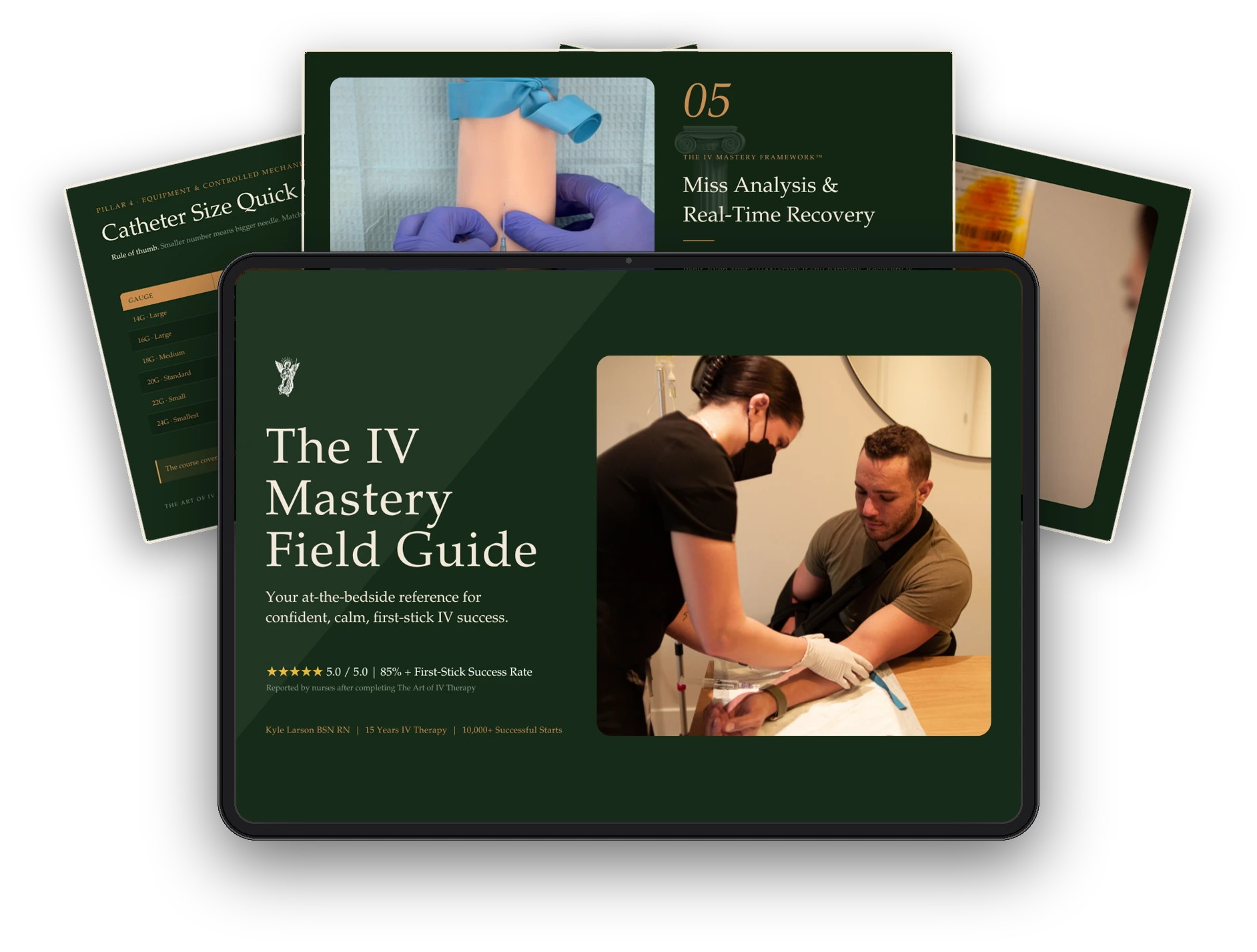
A free pocket field guide for landing the first stick calmly, every shift. Built on 5 core skills and 7 ready-to-use tools: checklists, patient scripts, and quick-reference cheat sheets you'll actually pull up at the bedside.
Inside: a catheter-size cheat sheet, insertion-angle guide, patient communication scripts, a pre-stick confidence checklist, and a missed-stick recovery protocol.
What Calm, First-Stick IVs Look Like



Most nurses practiced IVs only a handful of times before graduation. That's not a personal failing. It's a gap in nursing education — and it's the gap this guide closes.
higher first-attempt failure rate for new grads
of nurses struggle with IV placement
first-stick success reported after the course
The Stakes
What Happens When IVs Stay Hard
You spend every shift playing catch-up. Three sticks, then waiting on the IV team. You're forty minutes behind on rounds before you've found your rhythm.
You lose the patient's trust in the first thirty seconds. They came in nervous. The first thing they feel from you is a missed stick, and now they tense up for everything next.
You quietly become the nurse who passes the hard ones off. Word gets around. The tough IVs go to someone else, and somewhere along the way that became who you are on the unit.
The role you actually want stays just out of reach. ER, ICU, infusion, home health. Every one of them expects you to land an IV without thinking about it.
The dread never really goes away. The knot before a shift, replaying misses on the drive home. It doesn't fix itself with time. You just get used to carrying it.
This was never a personal failing. Nursing school gave you anatomy. Your first job gave you speed. No one ever taught you IVs as a system, and that gap doesn't close on its own. That's exactly what this guide is for.
What is the IV Mastery Framework™?
This guide is built on one system, the IV Mastery Framework™. Every tool inside maps to one of five core skills.
Here's how it's organized:

& Demographic
Awareness
Controlled
Mechanics
Real-Time
Recovery
Plus seven field-ready tools you'll actually use:
These Nurses Learned the Full System.
The Field Guide Is Your Free Starting Point.
Real nurses. Real reps. Real results.
Here's what happens when nursing students, new grads, and healthcare pros finally learn IVs using a system built on thousands of real-world sticks, not guesswork or school lectures.
The Field Guide is the free pocket version of The Art of IV Therapy, our full self-paced online video course.
"Online IV training that built my confidence. Clear lessons made techniques easy to follow. I learned vein selection and troubleshooting that improved comfort and boosted my confidence as a new grad RN fast."
"I didn't dread starting IVs anymore. When I graduated nursing school, I didn't feel very confident with IVs because we'd only done one or two in school. After taking this IV course, I felt more confident, more prepared."
"IV success is what you feel, not what you see. This course gave me tips for choosing veins you cannot see and keeping them stable. The feedback helped me stop going too deep and improved my success rate a lot."
"Great IV refresher for students and clinicians. A straightforward course that explains IVs and how to do them. Great for nursing students, nurses and other healthcare professionals who want more experience too."
"IV therapy finally clicked, and I felt ready. It made IV starts feel less intimidating and more doable. I loved the real-world focus on patient anxiety, communication, and nurse confidence, not just technique."
"Practical demos that made IVs easy to learn. Clearly organized and packed with tips that helped me build confidence in IV insertion and grow my clinical skills at my own pace."
Get the Field Guide Free
Keep it on your phone. Pull it up before your next hard stick: the catheter-size cheat sheet, the insertion-angle guide, the patient scripts, the missed-stick recovery protocol. Five skills, seven tools, one calmer shift at a time. You've got this.